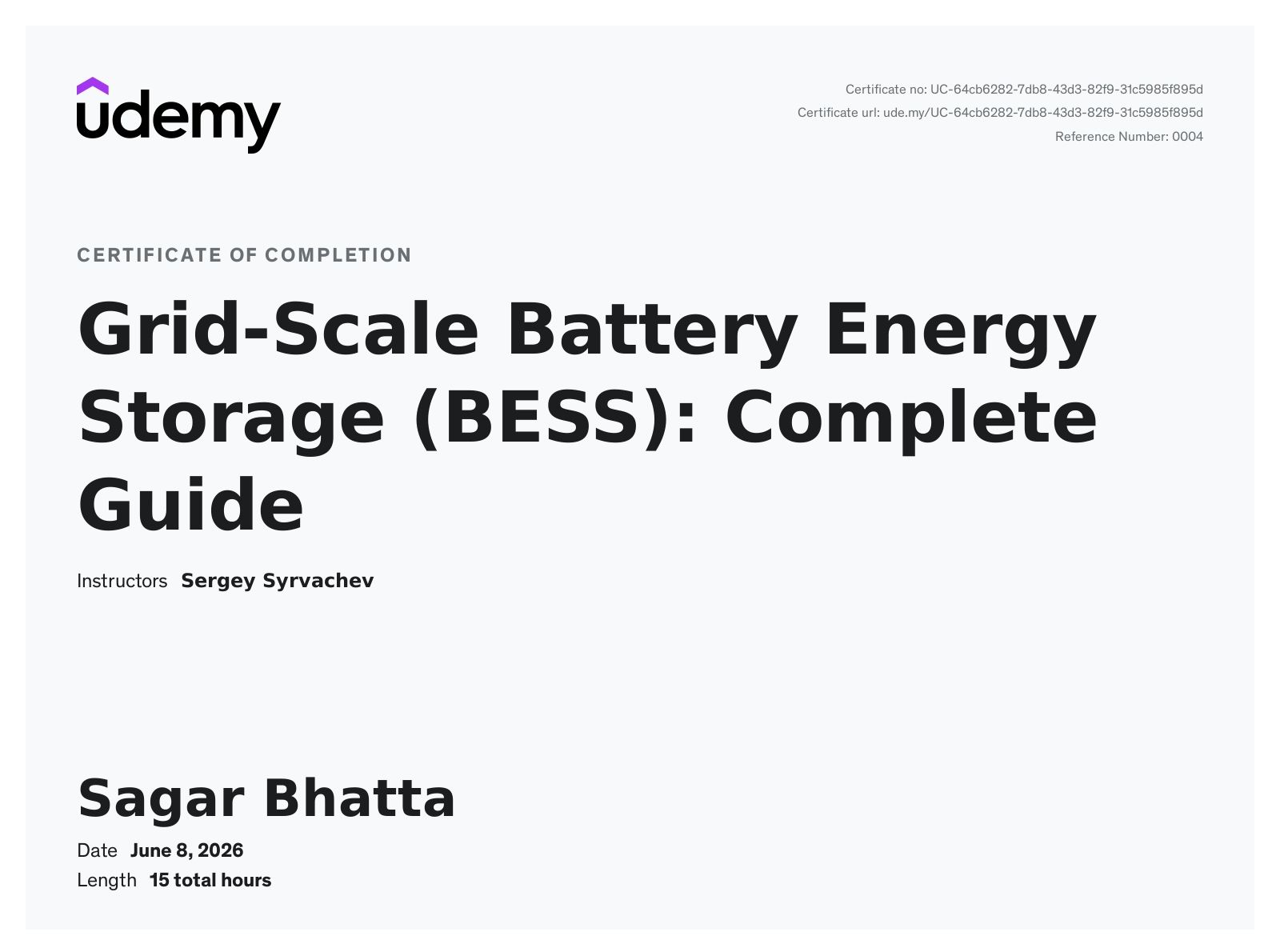
I recently completed the Grid scale battery class, a comprehensive 15-hours program covering the extensive technical and commercial depth of utility-scale battery energy storage systems from the cell level, electrochemistry, aging, augmentation strategies, control hierarchy, grid compliance, revenue optimization, project finance and the future of battery technology.
At the system level, system architecture (AC/DC Blocks), thermal management, and enclosure design have cascading implications on O&M cost, availability guarantees, and lender side due diligence. The control hierarchy from cell BMS through rack, string, and system BMS into PPC and EMS defines how a BESS operates safely and in compliance with grid codes. SOC estimation and balancing accuracy/ logic, and protection coordination directly determine real-world cycling performance and degradation outcomes. On the grid side, the shift from GFL to GFM technology is reshaping connection requirements across markets. Virtual inertia, FFR, FRT and voltage support are becoming mandatory as inverter-based resources replacing the synchronous generators. Revenue optimization requires stacking ancillary services, frequency regulation, energy arbitrage, and capacity market participation within the constraints of optimal dispatch logic.
From a project finance perspective, debt lenders scrutinize performance guarantees, degradation, augmentation cost models, and reports from independent engineers. Technical bankability is as critical as the offtake structure for lenders. A well-engineered asset poorly structured around these parameters will not survive lender scrutiny at financial close. Safety and compliance, thermal runaway propagation, fire suppression design, and noise simulation/mitigation directly affect permitting timelines, insurance terms, and project schedules. With the BESS market growing rapidly and cell chemistries diversifying into sodium-ion and solid-state batteries, the professionals leading this transition will be those who connect electrochemistry, plant controls, grid services/compliance, and project finance as one integrated system.
Thank you Sergey S. for building a well-structured course that helps the battery engineers to quickly review and understand the real complexity of utility scale battery projects.