ECO & Euro Efficiency
How ECO (CEC) and Euro efficiency are calculated from the same PCS curve — the formula and running sum, step by step.
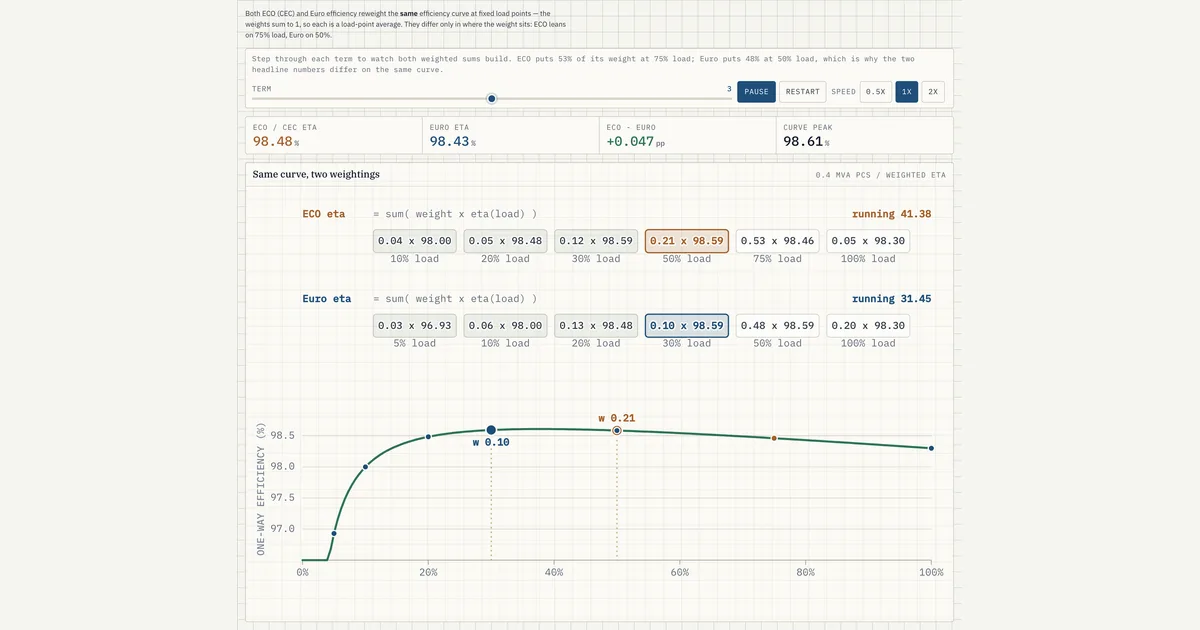
Both ECO (CEC) and Euro efficiency reweight the same efficiency curve at fixed load points — the weights sum to 1, so each is a load-point average. They differ only in where the weight sits: ECO leans on 75% load, Euro on 50%.
Download the ECO & Euro Efficiency diagram
Free to download and reuse — including commercially — under CC BY 4.0, with credit to BESS.engineer. Licence & attribution →
Browse all BESS diagrams →
What it shows
ECO (CEC) and Euro efficiency are two weighted averages of the same PCS efficiency curve, each collapsing the whole curve into one headline number. The visual steps through the six weighted terms of both standards side by side — ECO's weights (0.04, 0.05, 0.12, 0.21, 0.53, 0.05 at 10 to 100% load) and Euro's (0.03, 0.06, 0.13, 0.10, 0.48, 0.20 at 5 to 100%) — running the sum of weight times efficiency term by term until each lands on its total.
Why it matters for BESS
A PCS datasheet quotes efficiency as a single figure, but that number depends entirely on which load points you assume the unit spends its time at. ECO (CEC) and Euro are two published weighting schemes that answer that question differently, so identical hardware earns two different headline efficiencies. Knowing which standard a spec cites — and that this is one-way AC/DC conversion efficiency, not round-trip — is what makes a like-for-like procurement comparison honest.
How to read it
Each boxed term is one weight times the curve efficiency at that load, e.g. 0.53 x 98.46. Step through them and watch the running sum build; because the weights sum to 1, each total is a load-point average, not a product. The readout shows ECO eta, Euro eta, and their gap in pp. ECO reads marginally higher — but not because 75% load is the sweet spot: on this curve 50% (98.59%) actually sits a touch above 75% (98.46%). ECO edges ahead because Euro loads more weight onto the low-efficiency extremes — a 5% part-load term (~96.9%) and a heavy 0.20 weight at 100% (98.3%, vs ECO’s 0.05) — which outweighs its better-placed 50% term.
Frequently asked
- What is the difference between CEC and Euro efficiency?
- Both are weighted averages of the same inverter or PCS efficiency curve, taken at fixed load points whose weights sum to 1. CEC (the California Energy Commission scheme, shown here as ECO) puts its largest weight — 0.53 — at 75% load, while the European (Euro) scheme puts 0.48 at 50% load and adds a 5% load term. They differ only in where the weight sits, not in the underlying hardware.
- Why is ECO (CEC) efficiency higher than Euro efficiency?
- ECO weights 75% load most heavily (0.53); Euro weights 50% most heavily (0.48). On this curve those two points are close — 50% (98.59%) actually sits a hair above 75% (98.46%), so that is not what separates them. ECO ends up ~0.05 pp higher because Euro spreads more weight onto the low-efficiency extremes: a 5% part-load term (~96.9%) and a heavy 0.20 weight at 100% load (98.3%, vs ECO’s 0.05), both well below the 98.61% peak. The visual reports the gap directly in percentage points.
- Is PCS weighted efficiency the same as round-trip efficiency?
- No. Weighted efficiency here is a one-way AC/DC conversion figure for the PCS at various loads. Round-trip efficiency (RTE) is charge efficiency times discharge efficiency across the whole battery system, and it also folds in auxiliary loads and DC-side losses. A ~98% one-way PCS number is not an RTE and must never be labelled as one.
- Why weight efficiency by load point instead of quoting the peak?
- A PCS almost never runs at its peak-efficiency load, so the peak overstates real energy performance. Weighting the curve at representative load points gives a single number that reflects where the unit actually spends its time. Standards like CEC and Euro fix those weights so different products can be compared on the same basis.
- Do the CEC and Euro weights actually match how a BESS PCS is dispatched?
- No — both weighting schemes were built for PV inverters. The CEC weights were tuned to California solar irradiance, which is why 75% load carries the dominant 0.53; the Euro (EN 50530) weights come from lower-sunlight European operation, so their fixed load points assume a one-directional solar generation profile. A BESS PCS is bidirectional and is usually dispatched at higher, more concentrated load — often held near rated power during charge or discharge windows — so its realised part-load mix rarely looks like either curve. Treat the weighted number as a common yardstick for comparing hardware on the same basis, not as a literal prediction of the efficiency a BESS will see in service.
References
Standards and authoritative sources this visual is built on:
- EN 50530: Overall efficiency of grid connected photovoltaic inverters
- IEC 61683: Photovoltaic systems — Power conditioners — Procedure for measuring efficiency
- Performance Test Protocol for Evaluating Inverters Used in Grid-Connected Photovoltaic Systems (origin of the CEC weighted-efficiency formula)
- Grid Support / Photovoltaic Inverter Eligibility and CEC Weighted Efficiency Calculation