BESS Fire Safety and the NFPA 855, 68 & 69 Standards
A utility-scale battery fire is a real but well-characterized hazard, and modern BESS design manages it through layered engineering rather than a single safeguard. The dominant failure mode is thermal runaway — a self-heating chain reaction in a lithium-ion cell that vents flammable, sometimes explosive gas. Three NFPA standards address it in sequence: NFPA 855 governs how systems are sited and separated, NFPA 68 vents a deflagration if one occurs, and NFPA 69 prevents an explosive atmosphere from forming. UL 9540A fire testing supplies the numbers.
How a battery fire starts: thermal runaway
Almost every serious BESS fire begins with thermal runaway in a single lithium-ion cell. A manufacturing defect, physical damage, overcharge, over-temperature, or internal short pushes one cell past the point where its own chemistry turns exothermic; it then generates heat faster than it can shed it, ruptures, and vents a hot mix of flammable gases — hydrogen, carbon monoxide, and hydrocarbons. If that heat reaches neighboring cells, they follow, and runaway propagates from cell to module to rack.
This is why fire safety is framed around two goals, not one: prevent ignition, and arrest propagation and manage the vented gas when a single cell does fail. Every standard and every piece of hardware below maps to one of those two goals.
The standards stack: UL 9540, UL 9540A, and NFPA 855
Two UL documents and three NFPA standards form the framework, and they are routinely confused. UL 9540 is a product safety certification for the complete energy storage system — it lists the assembled ESS as compliant. UL 9540A is not a certification at all; it is a fire-propagation test method that measures how a cell, module, or unit behaves in runaway, producing the gas-generation and heat-release data used to justify a design. One certifies a product; the other characterizes a fire.
The NFPA standards then govern installation. NFPA 855 (current edition 2026, published 2025; the 2020 and 2023 editions are still what many jurisdictions enforce) is the installation standard — siting, spacing, ventilation, detection, suppression, and a required Hazard Mitigation Analysis (HMA). NFPA 68 covers deflagration venting; NFPA 69 covers explosion prevention. Editions matter here: always cite the year and confirm which edition your authority having jurisdiction has adopted, because separation, testing, and explosion-control requirements shifted across the 2020, 2023, and 2026 releases of NFPA 855.
Inside the container: NFPA 68 venting vs NFPA 69 prevention
Inside the enclosure, explosion risk is handled two ways at once, because there are two distinct jobs: prevent an explosive atmosphere from forming, and survive one if it does. NFPA 69 is prevention — a forced-exhaust fan and a flame-arrested fresh-air inlet continuously purge vented off-gas, keeping hydrogen and other flammables below the Lower Explosive Limit (LEL). NFPA 68 is the fallback — deflagration relief panels that, if gas does ignite, vent the overpressure to atmosphere so the steel container is not destroyed.
NFPA 855 treats these as alternative compliance paths — it requires explosion control per NFPA 68 or NFPA 69 — and deflagration venting (68) alone was long a common, fully compliant approach, though newer editions increasingly steer toward NFPA 69 prevention. Because the two do distinct jobs — preventing an explosive atmosphere (69) versus surviving one (68) — robust designs often layer both. Detection sits alongside them: smoke, heat, and gas sensors watch for the earliest signs of a venting cell so ventilation, alarms, and shutdown can act before conditions reach the LEL.
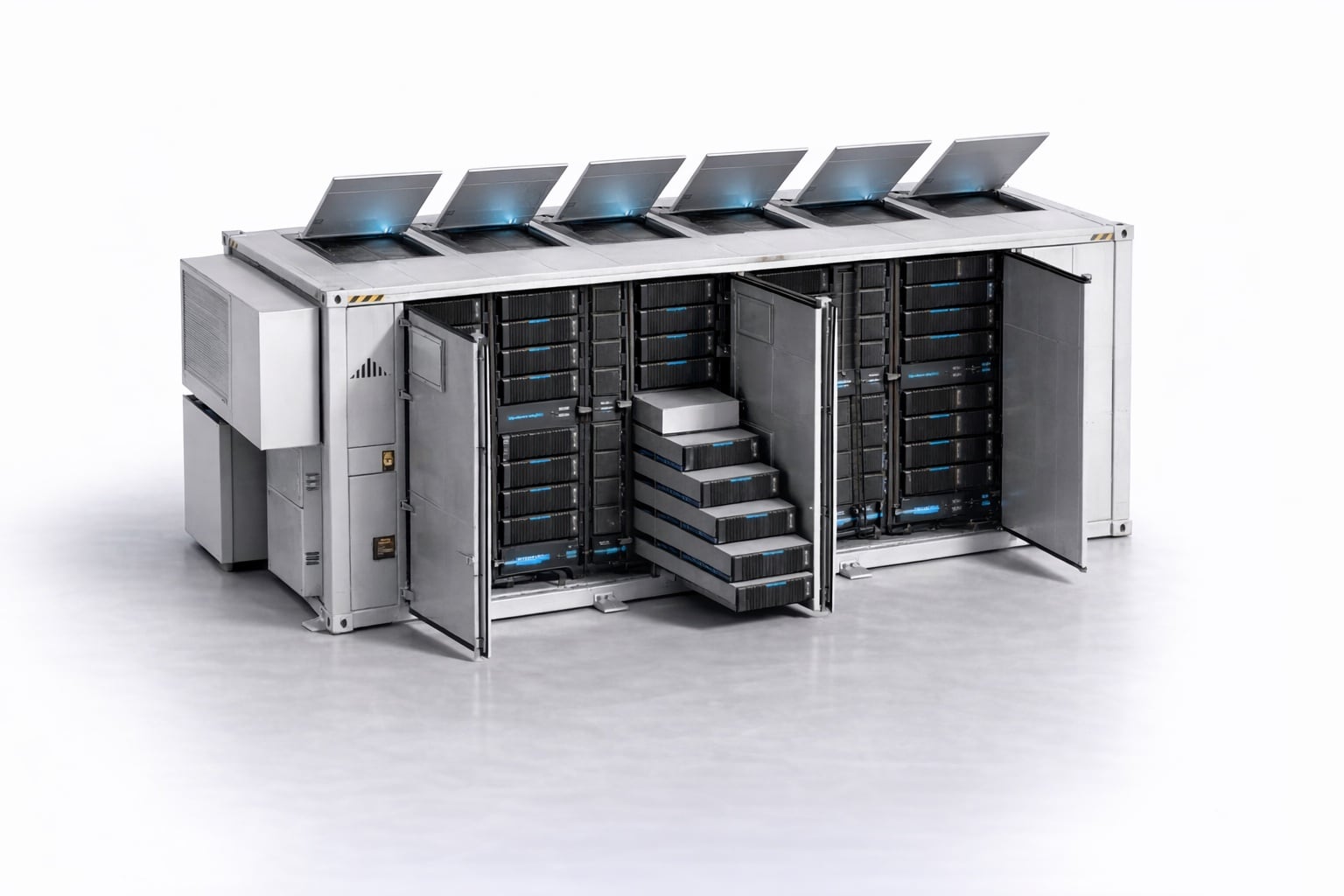
The container cutaway below marks the deflagration panels (NFPA 68), the exhaust fan and flame-arrested air inlet (NFPA 69), and the three detector types as separate labeled components — proving each protective layer has a distinct physical home.
The control layer that forces a safe state
Fire safety is as much a controls problem as a hardware one. The battery's control hierarchy — module sensing into the rack BMS, rack data into the container BMS — continuously enforces the current, voltage, and temperature limits the PCS must respect, and it is the layer that forces a defined safe state when something goes wrong. Fire and gas detection, door interlocks, and the emergency-stop chain take priority over normal dispatch: they drop the DC contactors, shut down the PCS, and command ventilation, then report the trip upward to the plant controller.
Upstream of any incident, HVAC holds cells at roughly 15–35 °C so a thermal event is less likely to start at all. The difference between a controlled trip and a propagating runaway often lives in exactly these signal paths. The container-controls map below traces the sensing, thermal, and safety chains from module voltage and temperature up to the container BMS and the E-stop circuit.
NFPA 855 siting, separation, and setback distance
At the site level, NFPA 855 governs where systems can go and how far apart. It limits stored energy per group, requires separation between ESS units and from exposures — buildings, lot lines, and vegetation — and mandates access for firefighting. The often-searched 'setback distance' has no single universal value: NFPA 855 establishes a baseline (commonly cited as roughly 3 ft / 0.9 m between units, with larger distances to exposures), but the governing distances are set by UL 9540A large-scale fire-test results and the project's Hazard Mitigation Analysis, which can require more separation or justify less.
This is why UL 9540A data matters commercially, not just technically — a unit that demonstrates no fire propagation to adjacent units in the test can often be sited more densely, while a poor result or a sensitive exposure forces units apart. Separation, access roads, and the position of the control building relative to the energy stations are all site-layout decisions. The site component map below shows how energy stations repeat across a plant and where separation and firefighting access apply.
So is a battery storage fire dangerous?
Yes, and it should be treated seriously. The vented gases are flammable and toxic, a fully involved container fire can burn for hours, and lithium-ion fires cannot be 'put out' in the conventional sense because the cell reaction is self-sustaining and generates its own heat and gas. The standard fire-service response is defensive: protect exposures, apply large volumes of water for cooling, and let the involved units burn down while preventing spread.
But 'dangerous' is not the same as 'uncontrolled.' The entire NFPA 855 / 68 / 69 / UL 9540A framework exists to keep a single-cell failure from becoming a site-wide event, and a system built and sited to those standards confines the hazard to a defined, planned-for footprint. The engineering answer to battery fire risk is not that it cannot happen — it is that it is contained by design.
Frequently asked
- Is a battery storage fire dangerous?
- Yes. A lithium-ion BESS fire vents flammable and toxic gas, can burn for hours, and cannot be extinguished conventionally because thermal runaway is self-sustaining. The fire-service response is defensive — cool exposures with water and let involved units burn down. But the risk is engineered against: NFPA 855 siting, NFPA 68/69 explosion control, and UL 9540A fire testing are designed to keep a single failed cell from becoming a site-wide event, confining the hazard to a planned footprint.
- What is NFPA 855?
- NFPA 855 is the Standard for the Installation of Stationary Energy Storage Systems, first published in 2020, with editions in 2020, 2023, and a current 2026 edition (published 2025), though many jurisdictions still enforce the 2020 or 2023 edition. It governs how an ESS is sited and installed: unit spacing and separation, stored-energy limits, ventilation, fire detection and suppression, explosion control (via NFPA 68 or NFPA 69), commissioning, and a required Hazard Mitigation Analysis. It references UL 9540 for the system listing and UL 9540A for fire-propagation test data. It is an installation standard, not a product test.
- What is the NFPA 855 setback distance?
- There is no single fixed number. NFPA 855 sets baseline separation — commonly cited as about 3 ft (0.9 m) between units, with larger distances to exposures like buildings and lot lines — but the governing distances are determined by UL 9540A large-scale fire-test results and the site's Hazard Mitigation Analysis. Demonstrating limited fire propagation in UL 9540A testing can justify reduced spacing; a poor result or a sensitive exposure can require more. Always work from the specific edition and the authority having jurisdiction.
- What is the difference between UL 9540 and UL 9540A?
- UL 9540 is a product safety certification: it lists the complete, assembled energy storage system as compliant with electrical and safety requirements. UL 9540A is a fire-propagation test method — not a certification — that measures how a cell, module, or unit behaves in thermal runaway, producing the gas-release and heat data used to justify separation distances and explosion-control design under NFPA 855. They sound alike but do opposite things: one certifies a product, the other characterizes a fire.
- What causes thermal runaway in a BESS?
- Thermal runaway is a self-heating chain reaction inside a lithium-ion cell. A defect, physical damage, overcharge, over-temperature, or internal short pushes one cell past the point where its chemistry becomes exothermic; it then generates heat faster than it can dissipate it, ruptures, and vents hot flammable gas. If that heat reaches neighboring cells, they too enter runaway, so it propagates cell to module to rack. BESS safety design aims both to prevent ignition and to arrest this propagation.
- Is LFP safer than NMC for BESS fire safety?
- LFP (lithium iron phosphate) is harder to drive into thermal runaway than NMC. Its olivine cathode holds oxygen in strong P–O bonds and does not shed it as the cell heats, whereas NMC's layered-oxide cathode releases oxygen that feeds combustion — so LFP reaches runaway at a higher onset temperature (roughly 200–270 °C versus about 150–210 °C for NMC) and then vents lower-heat, less energetic gas. That wider margin slows cell-to-cell propagation and makes it easier to arrest, and it is a main reason most new utility-scale BESS is LFP. But more tolerant is not immune: an LFP cell still vents flammable, hydrogen-rich gas and can still propagate, so the same NFPA 855 / 68 / 69 and UL 9540A framework applies regardless of chemistry.
- What fire suppression does a battery energy storage system use?
- It is layered, and gas alone is not enough. Clean agents (FK-5-1-12 / Novec 1230, inert gases) and condensed aerosols can knock down open flame but provide little cooling, so they rarely stop thermal runaway from propagating cell to cell — a runaway cell's cathode releases oxygen internally, leaving oxygen-displacing agents nothing to act on at the source, and testing confirms clean agent at typical design concentrations does not reliably arrest propagation. What slows propagation is bulk cooling, so water — sprinklers, deluge, or direct application — carries the real load, which is why NFPA 855 and FM Global rely on water-based suppression for indoor lithium-ion ESS. The accepted posture, backed by UL 9540A test data, is detection plus explosion control (NFPA 68 venting or NFPA 69 prevention) plus copious cooling water, often accepting a controlled burn-down of the affected unit while protecting the exposures around it.
References
Standards and authoritative sources behind this guide:
- NFPA 855, Standard for the Installation of Stationary Energy Storage Systems
- NFPA 68, Standard on Explosion Protection by Deflagration Venting
- NFPA 69, Standard on Explosion Prevention Systems
- UL 9540A, Test Method for Evaluating Thermal Runaway Fire Propagation in Battery Energy Storage Systems
- IEC 62933-5-2: Electrical energy storage (EES) systems — Part 5-2: Safety requirements for grid-integrated EES systems — Electrochemical-based systems
- UL 9540: Standard for Energy Storage Systems and Equipment
- UL 1973: Standard for Batteries for Use in Stationary and Motive Auxiliary Power Applications
- IEC 62933-2-1:2018 — Electrical Energy Storage (EES) Systems — Part 2-1: Unit Parameters and Testing Methods (General Specification)
- DOE/EPRI Electricity Storage Handbook in Collaboration with NRECA (SAND2015-1002) — Battery Storage System Architecture, Power Conversion, Transformers and Grid Interconnection