BESS Container Structure
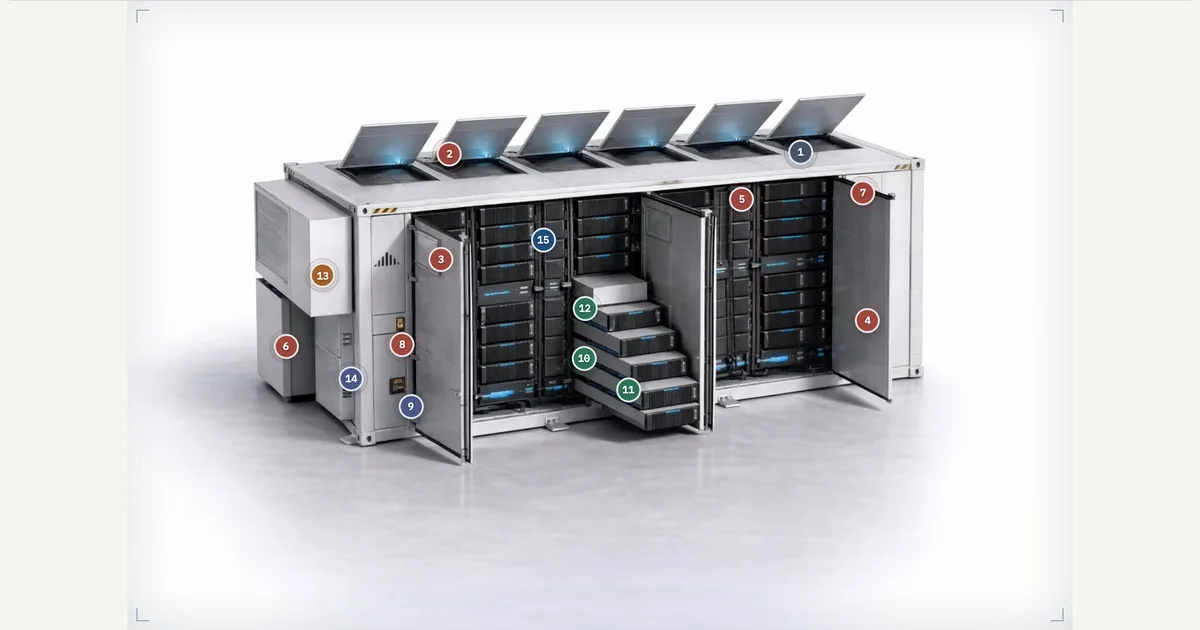
Inside the container: battery racks, service zones, ventilation, and safety relief.
Part of: the BESS block diagram — see every layer of the system in one place.
Download the BESS Container Structure diagram
Free to download and reuse — including commercially — under CC BY 4.0, with credit to BESS.engineer. Licence & attribution →
Browse all BESS diagrams →
What it shows
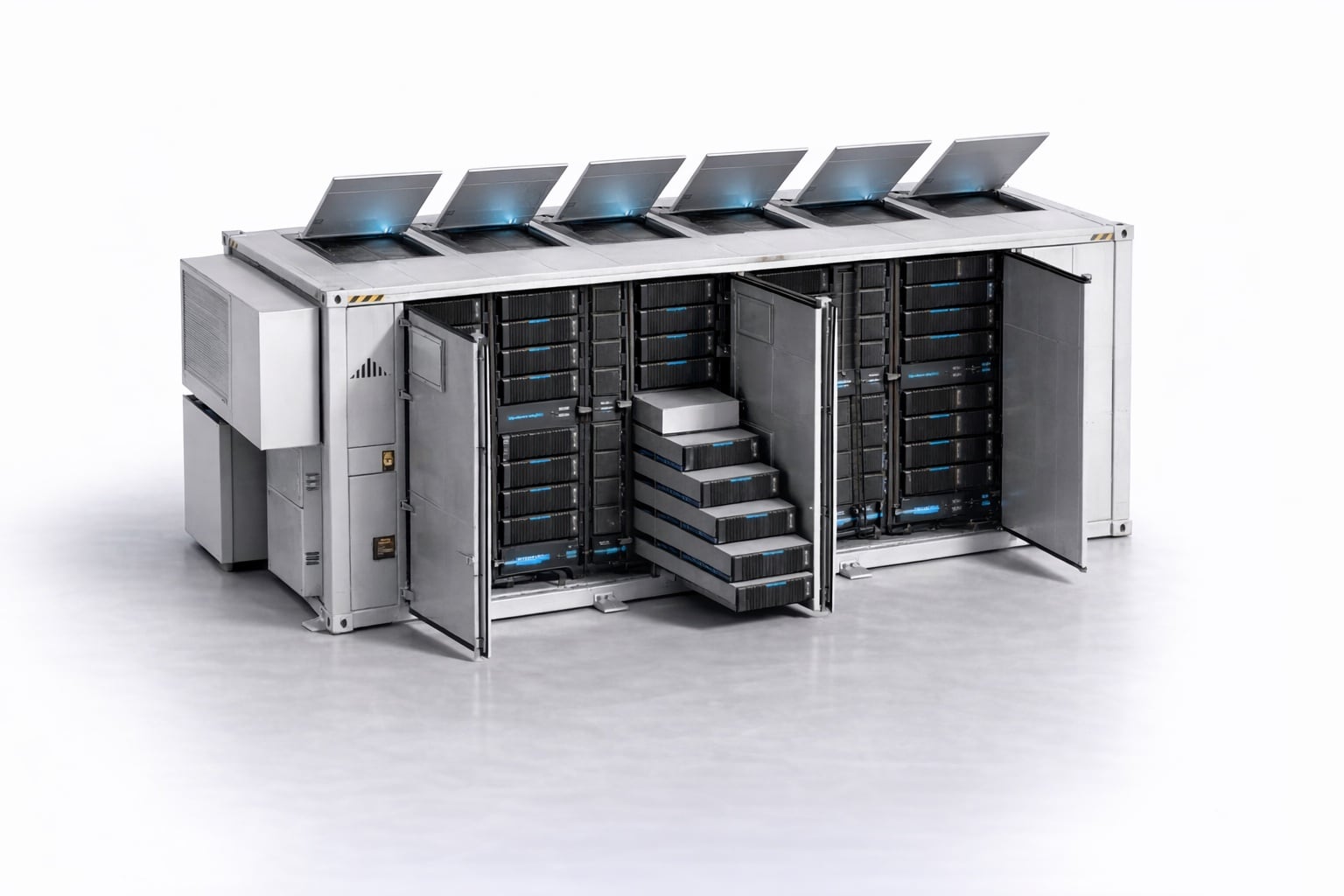
A BESS container is the weatherproof steel enclosure that houses a battery system's racks, thermal management, and safety hardware as one transportable unit. This annotated cutaway maps 15 components across six systems — structure, safety and venting, thermal, access, battery, and electrical. Hover or tap any marker to inspect one part: the battery racks and modules, the BCU box, HVAC, deflagration panels, exhaust and inlet, detection, and the interlocked access doors.
Why it matters for BESS
The container is the integration boundary where cells, controls, and protection meet. Li-ion cells in thermal runaway vent flammable off-gas, so the enclosure must both prevent an explosive atmosphere and survive one if it forms — two distinct jobs handled by different standards. Seeing racks, HVAC, detection, and venting together clarifies why a container is engineered as a fire-safety system, not just a box of batteries, and where each protective layer physically lives.
How to read it
Trace the hierarchy inward: container enclosure to bay to rack to module, with the BCU box supervising each string's cell voltages, temperatures, SOC, and SOH. Note the two-standard split — deflagration panels vent overpressure per NFPA 68, while the forced exhaust fan and flame-arrested air inlet purge off-gas below the LEL per NFPA 69. HVAC holds cells at 15–35 °C; the E-stop drops DC contactors; door interlocks block opening under live high voltage.
Frequently asked
- What is a BESS battery rack?
- A BESS battery rack is the server-style frame inside a battery container that holds a vertical stack of lithium-ion modules wired in series into one high-voltage DC string, with a rack-level Battery Cluster Unit (BCU) managing balancing, contactors, and protection. A grid-scale container holds several such racks side by side; the rack is the unit you service, isolate, and augment. Racks feed the container busbar, which the PCS converts to grid AC.
- What is inside a BESS container?
- A BESS container holds lithium-ion battery modules stacked in server-style racks, a per-rack Battery Cluster Unit (BCU) that manages balancing and reports SOC and SOH, and an electrical cabinet with busbars and fuses. Around the batteries sit an HVAC unit for temperature control, ventilation and deflagration panels for off-gas safety, fire detection and suppression, an E-stop, and a UPS for control-system backup. Access doors on each bay open for rack-level service.
- What is the difference between NFPA 68 and NFPA 69 in a battery container?
- They address explosion risk in two different ways. NFPA 68 covers deflagration venting — the pressure-relief panels that let an ignited gas explosion vent harmlessly to atmosphere so the enclosure survives. NFPA 69 covers explosion prevention — the forced-exhaust fan and fresh-air inlet that continuously purge flammable off-gas (like hydrogen from thermal runaway) to keep concentrations below the Lower Explosive Limit. NFPA 855 lets you meet explosion control with either standard (newer editions increasingly favour NFPA 69 prevention), and because the two do distinct jobs — preventing an explosive atmosphere versus surviving one — robust designs often layer both.
- How are battery cells, modules, and racks organized in a container?
- The hierarchy runs cell to module to rack to container. Cells are grouped into a field-replaceable module with its own busbars, temperature sensors, and cell-level fuse; modules are wired in series and parallel within a rack to reach the target voltage and capacity; racks fill each bay of the container. A BCU box supervises each string, and racks are hot-swap compatible so a module can be replaced without a full system shutdown.
- How is a BESS container kept at the right temperature?
- A side-mounted HVAC unit maintains the battery compartment within its optimal operating range, typically 15–35 °C. It uses a refrigeration cycle for cooling and electric heating for cold climates, and is controlled by the BMS based on cell-temperature feedback. Holding cells in this band protects capacity and cycle life and keeps temperature gradients across modules low.
- How big is a BESS container and how much energy does it hold?
- Most grid-scale enclosures use the 20 ft high-cube footprint — roughly 6 m long, 2.4 m wide, and 2.9 m tall — or purpose-built cabinets of similar size. Capacity is set by cell chemistry and packing density, not by the box: a 20 ft LFP unit held about 3.4 MWh in early 2023, reached roughly 5 MWh with 314 Ah cells by late 2023, and now hits 6+ MWh with larger-format (587 Ah) cells, while purpose-built platforms exceed 7 MWh. Because the shell stays fixed while cell density keeps climbing, treat any figure as a snapshot of the current cell generation.
References
Standards and authoritative sources this visual is built on:
- NFPA 855, Standard for the Installation of Stationary Energy Storage Systems
- NFPA 68, Standard on Explosion Protection by Deflagration Venting
- NFPA 69, Standard on Explosion Prevention Systems
- UL 9540A, Test Method for Evaluating Thermal Runaway Fire Propagation in Battery Energy Storage Systems