Energy Station Structure
The power path from grid equipment to PCS and battery containers.
Part of: the BESS block diagram — see every layer of the system in one place.
Download the Energy Station Structure diagram
Free to download and reuse — including commercially — under CC BY 4.0, with credit to BESS.engineer. Licence & attribution →
Browse all BESS diagrams →
What it shows
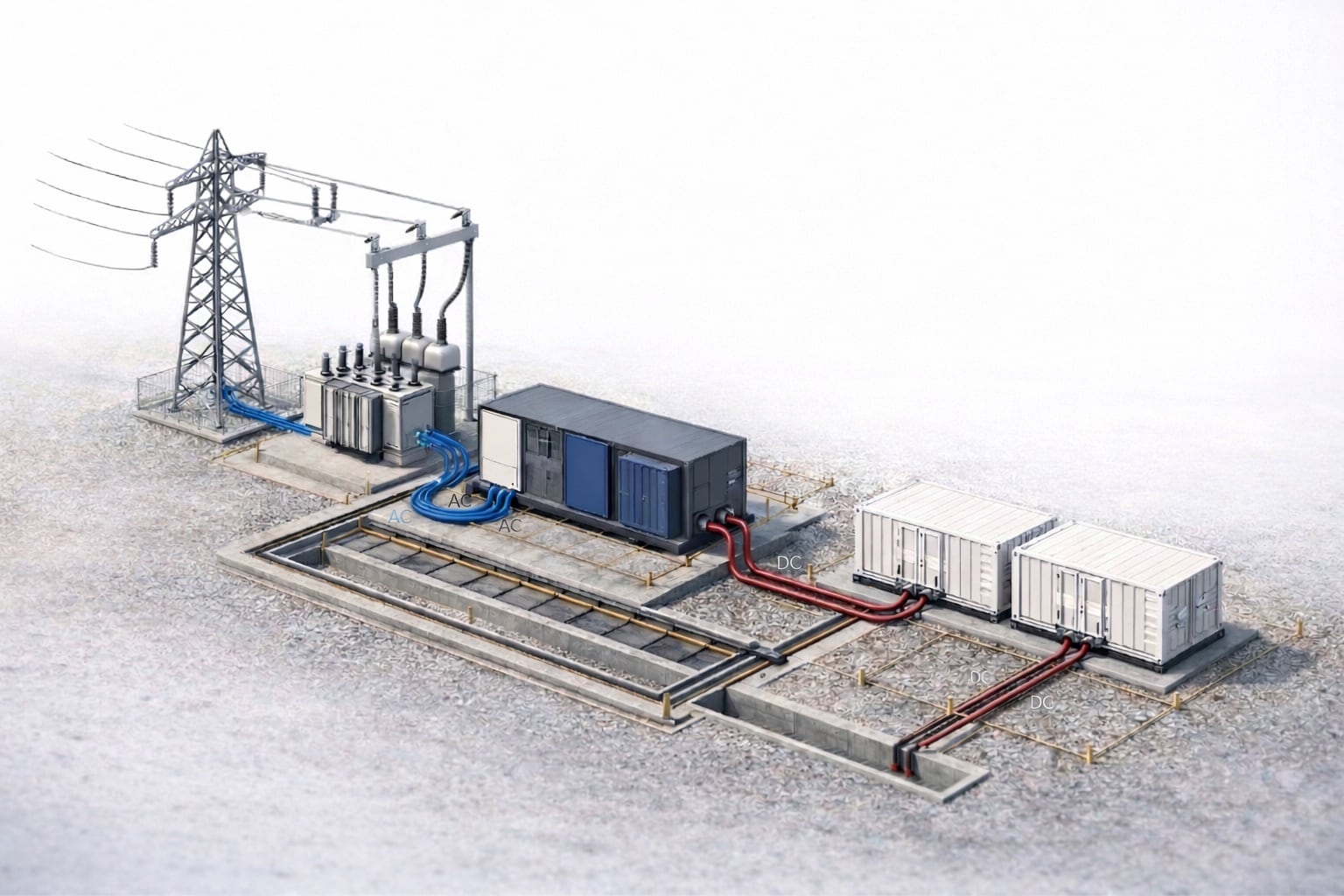
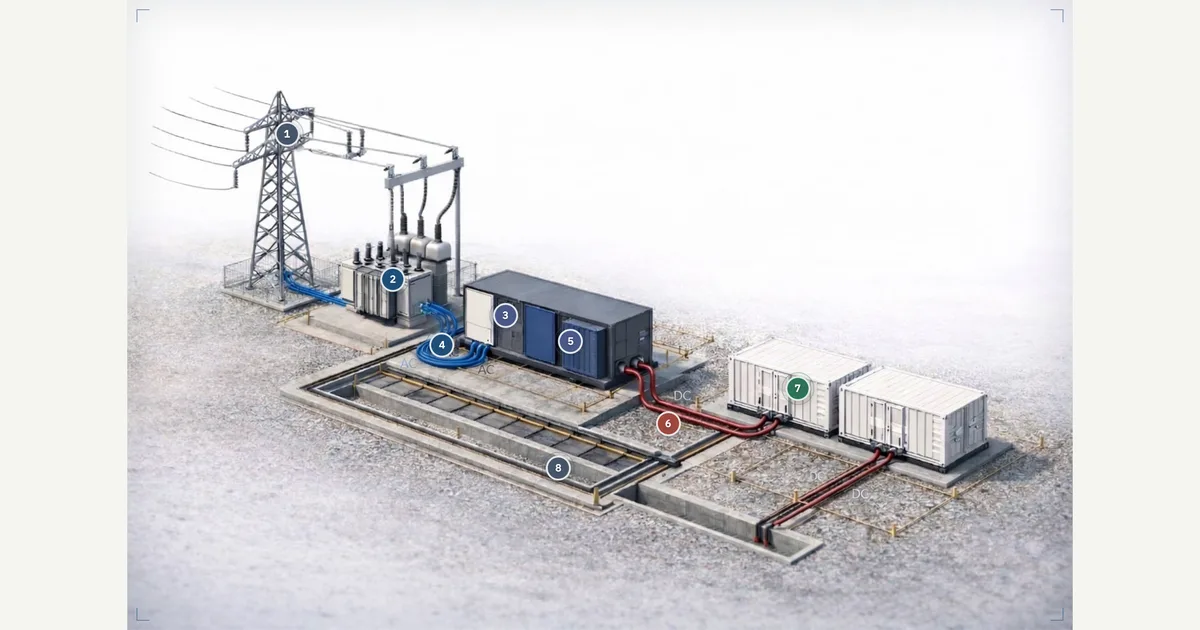
An energy station is the physical site that connects a battery to the grid, and this annotated site view traces its power path across eight markers. Grid power arrives at a transmission tower above 115 kV, steps down through the substation intertie transformer at the point of interconnection, and reaches an MV transformer and PCS mounted together on a skid. The PCS converts AC to DC, DC cables feed the battery containers, and a concrete trench network routes every run. Hover a marker to follow the flow.
Why it matters for BESS
A battery project is a chain of voltage and conversion boundaries, and knowing where each one sits governs equipment sizing, protection, and loss accounting. The intertie transformer defines the point of interconnection — the commercial and metering boundary with the grid. The PCS is the single point where AC becomes DC, so everything upstream is three-phase AC at grid or medium voltage and everything downstream is the DC battery bus. Mixing those domains is the most common way a one-line diagram goes wrong.
How to read it
Follow the colour categories: AC Power Path and Civil Works run from the transmission tower down to the substation intertie transformer, which handles 11-33 kV medium voltage on the collection side. Power Conversion covers the skid-mounted MV transformer and PCS, where AC meets DC. The DC Power Path then carries current to the Battery Storage containers, each holding racks, BMS, thermal management, and fire safety. On charge, the same path runs in reverse — the transformer steps down and the PCS rectifies AC to DC.
Frequently asked
- What is the point of interconnection in a BESS?
- The point of interconnection (POI) is where the battery site connects to the grid — physically at the substation intertie transformer. On export it steps the medium-voltage collection network (11-33 kV) up to transmission level; on charge it steps transmission HV back down to MV. The POI is also the commercial metering boundary where the project's power is measured.
- Where does AC become DC in a battery storage station?
- At the PCS (Power Conversion System). Everything upstream of the PCS — the transmission tower, intertie transformer, MV skid transformer, and blue AC cables — is three-phase AC. The PCS inverts DC to AC when discharging and rectifies AC to DC when charging, so the DC cables and battery containers downstream operate on the DC battery bus.
- How do battery containers connect to an energy station?
- Each energy station pairs one PCS/MV skid with a set of battery containers wired to its DC bus — commonly two to six containers per skid, sized by the target power and duration. The containers are the DC storage layer; the skid is the AC/DC conversion and step-up point that joins them to the medium-voltage collection network.
References
Standards and authoritative sources this visual is built on:
- IEEE 2800-2022 — Standard for Interconnection and Interoperability of Inverter-Based Resources (IBRs) Interconnecting with Associated Transmission Electric Power Systems
- IEEE 1547-2018 — Standard for Interconnection and Interoperability of Distributed Energy Resources with Associated Electric Power Systems Interfaces
- IEC 62933-1 — Electrical Energy Storage (EES) Systems — Part 1: Terminology (Vocabulary)
- Grid-Scale Battery Storage: Frequently Asked Questions (NREL/TP-6A20-74426)