Lithium-Ion Cell
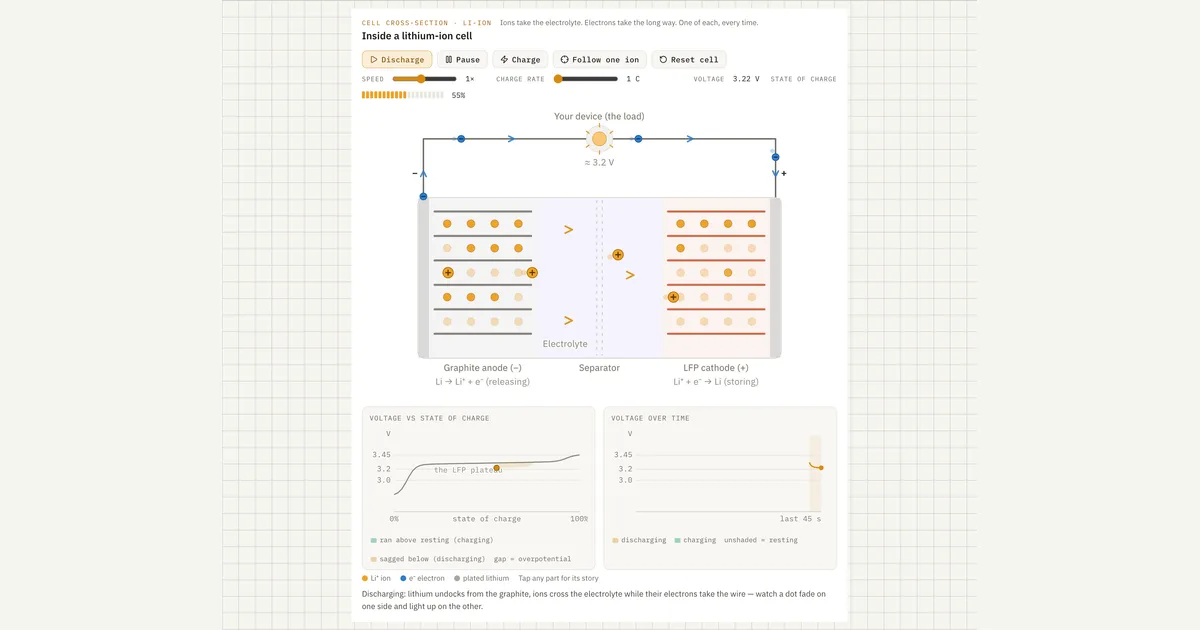
A cell cross-section showing how ions move through the electrolyte and electrons take the external circuit during charge and discharge.
Part of: the BESS block diagram — see every layer of the system in one place.
Inside a lithium-ion cell
Download the Lithium-Ion Cell diagram
Free to download and reuse — including commercially — under CC BY 4.0, with credit to BESS.engineer. Licence & attribution →
Browse all BESS diagrams →
What it shows
Inside a lithium-ion cell, charge moves two ways at once. Lithium ions shuttle through the electrolyte between the negative and positive electrodes, while the matching electrons are forced through the external circuit — one of each, every time. On discharge the cell releases stored energy and state of charge falls; on charge an external source pushes ions back and state of charge rises. Cell voltage tracks the open-circuit curve plus the resistive drop set by C-rate.
Why it matters for BESS
A grid-scale battery is thousands of these cells in series and parallel. Every system-level number — usable energy, round-trip efficiency, C-rate limits, degradation — originates at the cell. Seeing the ion-and-electron split makes the rest of the storage stack (modules, racks, BMS, container) read as scaled-up copies of this one electrochemical loop.
Frequently asked
- How does a lithium-ion cell work?
- During discharge, lithium ions move through the electrolyte from the negative to the positive electrode while electrons flow through the external circuit to power the load. Charging reverses both flows using an external energy source.
- What is the difference between charge and discharge?
- Discharge releases stored energy to a load and lowers state of charge; charge uses an external source to drive ions back into the negative electrode and raises state of charge. Higher C-rate (faster charge/discharge) increases the resistive voltage drop and heat.
- Which lithium-ion chemistry is used in grid-scale BESS?
- Nearly all new grid-scale storage uses LFP (lithium iron phosphate), a ~3.2 V cell chosen for thermal stability, long cycle life (~4,000–10,000 cycles), and low cost. Its thermal-runaway onset near ~270 °C sits well above the ~150–210 °C of NMC (nickel manganese cobalt), which runs a higher ~3.6–3.7 V and stores more energy per kilogram — an edge that matters in EVs but not in stationary systems where footprint is cheap. Sodium-ion is the emerging alternative, trading energy density for lower cost and lithium- and cobalt-free supply chains.
References
Standards and authoritative sources this visual is built on:
- IEEE 1679.1-2017 — IEEE Guide for the Characterization and Evaluation of Lithium-Based Batteries in Stationary Applications
- IEC 62620:2014 — Secondary cells and batteries containing alkaline or other non-acid electrolytes — Secondary lithium cells and batteries for use in industrial applications
- The Li-Ion Rechargeable Battery: A Perspective (J. B. Goodenough and K.-S. Park), Journal of the American Chemical Society 135(4), 1167–1176
- Battery Test Manual for Electric Vehicles (defines C-rate, state of charge, open-circuit voltage, and cell resistance test methods)