AC-Coupled vs DC-Coupled Solar-Plus-Storage
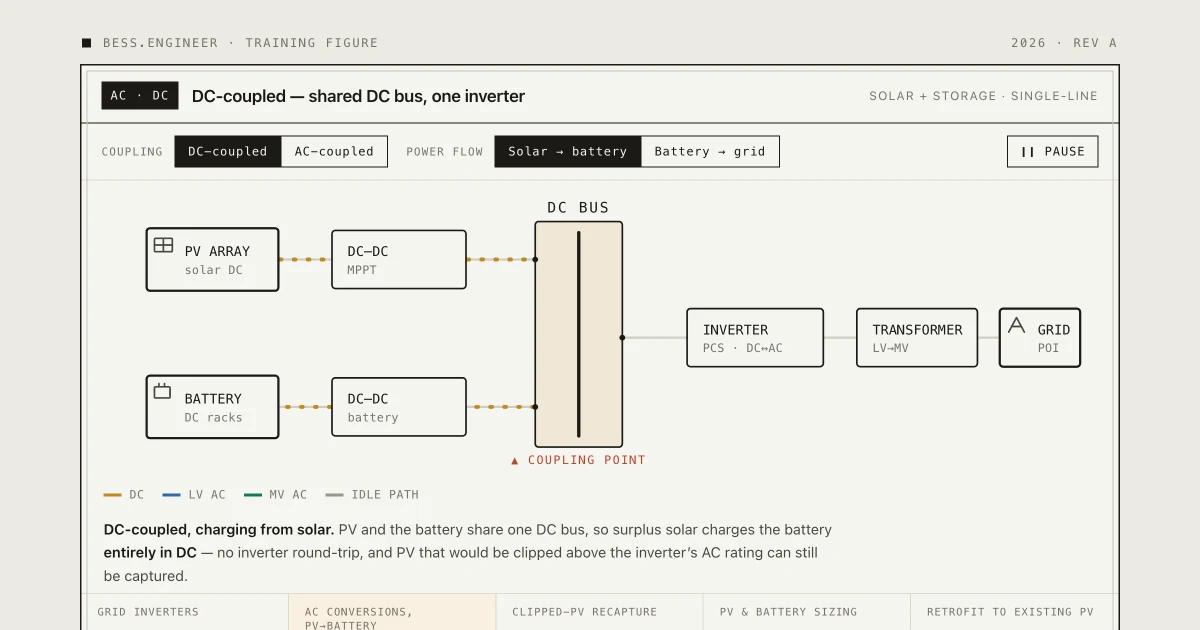
Flip between two single-line topologies for a PV-plus-battery hybrid: one shared inverter on a DC bus, or separate PV and battery inverters on AC. The coupling point drives charging losses, clipping recovery, and retrofit cost.
Part of: the BESS single-line diagram guide — the single-line diagrams and layouts behind it.
Download the AC-Coupled vs DC-Coupled Solar-Plus-Storage diagram
Free to download and reuse — including commercially — under CC BY 4.0, with credit to BESS.engineer. Licence & attribution →
Browse all BESS diagrams →
The one difference that matters
Everything about AC- vs DC-coupling comes down to a single question: where do the solar array and the battery meet? In a DC-coupled plant they share one DC bus behind a single bidirectional grid inverter (PCS) — PV joins through a DC-DC/MPPT converter and the battery through its own bidirectional DC-DC stage. In an AC-coupled plant the PV has its own inverter and the battery has its own PCS, and the two only meet after both have already been turned into AC. Fix that coupling point in your head and every trade-off below follows from it. Scope note: this is strictly a PV+battery hybrid decision — a standalone grid battery with no on-site PV is inherently AC-connected through its PCS.
Single- vs double-conversion loss stack
Every conversion pass — DC-to-AC, AC-to-DC, or DC-to-DC — costs on the order of 1-2%; modern utility inverters and battery PCS peak near 98-99% (about 98% weighted efficiency) and DC-DC stages sit in the same band. Charging the battery from PV in a DC-coupled plant stays entirely on DC, crossing a single DC-DC pass. In an AC-coupled plant the same energy is inverted DC-to-AC at the PV inverter and then rectified AC-to-DC at the battery PCS — a double conversion. NREL's Annual Technology Baseline quantifies the gap: it models a DC-coupled system at about 87% round-trip efficiency charging from the coupled PV versus 85% from the grid, and that roughly 2-point difference is exactly the AC/DC conversion the DC-coupled path avoids. On the one-way solar-charge leg the saving is about 1-2 points. When the plant simply exports PV straight to the grid, the two architectures are comparable — the DC advantage is specific to solar-charging the battery and to catching clipped energy.
Shared ceiling vs independent equipment
Because DC-coupled PV and battery share one inverter, their combined AC export is hard-capped at that inverter's rating: dispatch is coupled, controls and sizing are tighter, and retrofitting is awkward. The compensating advantage is clipping recovery. Utility PV is deliberately oversized relative to its inverter (inverter loading ratios typically 1.13-1.30, with NREL's 2024 ATB modeling utility PV at 1.34), so on bright days the DC array produces more than the AC rating and the excess is normally clipped. On a shared DC bus that surplus is steered into the battery instead of being curtailed, which is why DC-coupled designs can push ILR higher. AC-coupled cannot recover energy clipped inside the PV inverter, but in return PV and battery are sized, sited, dispatched, and warranted independently with standard separate equipment — the natural, lower-risk way to retrofit storage onto an existing PV plant.
Frequently asked
- What is the difference between AC-coupled and DC-coupled battery storage?
- It is an architecture choice for a solar-plus-storage (PV + battery) hybrid. In a DC-coupled plant the PV array and battery share a common DC bus behind a single bidirectional grid inverter (PCS): PV joins through a DC-DC/MPPT converter and the battery through its own DC-DC stage, and one inverter converts the combined DC to AC. In an AC-coupled plant the PV has its own inverter and the battery has its own PCS, and the two tie together on the AC side (an LV or MV bus) ahead of the step-up transformer. The coupling point — shared DC bus versus shared AC bus — is the whole difference; every other trade-off follows from it. A standalone grid battery with no PV is always AC-connected, so this decision only arises once solar and storage share a site.
- Why is DC-coupled more efficient for charging the battery from solar?
- Because it avoids a conversion. Every DC-to-AC or AC-to-DC pass costs roughly 1-2%. In a DC-coupled plant, PV energy going into the battery stays on the DC bus and crosses only a DC-DC stage (about 98-99%). In an AC-coupled plant the same energy must be inverted DC-to-AC at the PV inverter and then rectified AC-to-DC at the battery PCS — a double conversion. NREL's ATB reflects this: a DC-coupled system is modeled at about 87% round-trip efficiency charging from coupled PV versus 85% from the grid, a roughly 2-point round-trip gain from the avoided AC/DC pass. Note this advantage is specific to solar-charging the battery; for PV exported straight to the grid the two architectures are comparable.
- What is clipping, and why does DC-coupling recover it?
- Utility PV arrays are deliberately oversized relative to their inverters (inverter loading ratio, or DC:AC ratio, typically 1.13-1.30; NREL's 2024 ATB models 1.34). On sunny days the DC array can produce more than the inverter's AC rating, and the excess is clipped — the array is backed off its maximum-power point and that energy is lost, on the order of 1-3% of annual energy at typical ratios and more at higher ILR. In a DC-coupled system the battery sits on the same DC bus, so surplus above the AC ceiling is diverted into the battery rather than clipped. In an AC-coupled system the clipping happens inside the PV inverter, before the AC bus, so the battery cannot recover it.
- Which architecture is better for retrofitting storage onto an existing solar farm?
- AC-coupling, almost always. The existing PV plant already has its own inverters feeding an AC bus; you add a battery with its own PCS onto that same AC bus and leave the PV side untouched. It also lets PV and battery be sized, sited, dispatched, and warranted independently with standard, separately-rated equipment. DC-coupling would mean getting behind the existing PV inverters onto the DC bus and re-engineering the conversion chain, which is rarely practical on an operating plant — it is best suited to new-build hybrids designed as one system from the start.
- Do standalone grid batteries use AC or DC coupling?
- Standalone batteries with no on-site solar are inherently AC-connected: the bidirectional PCS converts battery DC to AC and ties straight to the transformer and grid. AC-versus-DC coupling is specifically a solar-plus-storage decision about where the PV array and battery meet, so it does not apply to a battery-only site.
- What is AC coupling in a solar battery system?
- AC coupling means the solar array and the battery each have their own inverter and are joined on the AC side. The PV inverter turns solar DC into AC on a shared LV or MV bus, and the battery sits on that same AC bus behind its own bidirectional PCS. Because the two are independent, AC coupling is the standard way to add a battery to an existing solar system, and PV and battery can be sized separately — the trade-off is that charging the battery from solar takes a DC-to-AC-to-DC double conversion, and solar clipped inside the PV inverter never reaches the battery.
References
Standards and authoritative sources this visual is built on:
- Annual Technology Baseline (ATB) 2024: Utility-Scale PV-Plus-Battery (DC-coupled round-trip efficiency 85% grid / 87% coupled-PV) and Utility-Scale PV (inverter loading ratio 1.34)
- Evaluating the Technical and Economic Performance of PV Plus Storage Power Plants (NREL/TP-6A20-68737) — AC- vs DC-coupled architectures and inverter clipping
- Solar plants typically install more panel capacity relative to their inverter capacity (DC/AC or inverter-loading ratio typically 1.13–1.30), Today in Energy
- 2022 Grid Energy Storage Technology Cost and Performance Assessment (PNNL-33283) — lithium-ion system round-trip efficiency and conversion losses