Neutral Current (4-Wire Wye)
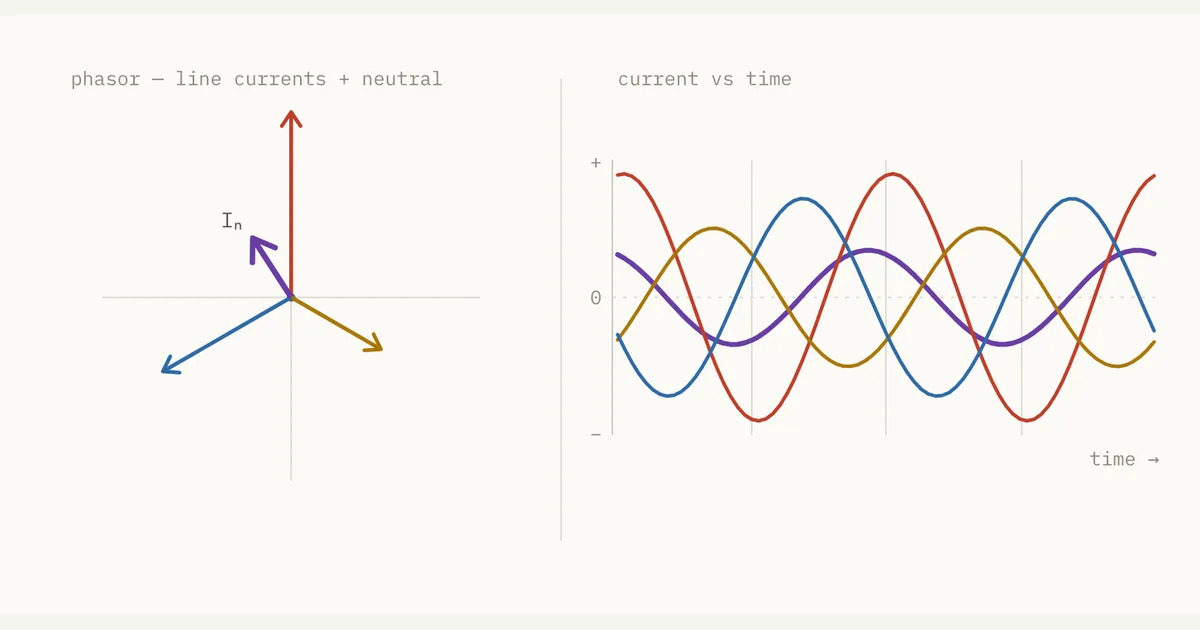
In a 4-wire wye system the neutral carries the vector sum of the three line currents — balanced they cancel, unbalanced the difference flows back as neutral current.
Download the Neutral Current (4-Wire Wye) diagram
Free to download and reuse — including commercially — under CC BY 4.0, with credit to BESS.engineer. Licence & attribution →
Browse all BESS diagrams →
What it shows
Neutral current is the current that flows back through the neutral of a 4-wire wye system, equal to the vector sum of the three line currents (I_N = ΣI). Here L1, L2 and L3 are drawn as phasors from a common origin and as three time waveforms, with the neutral added as a fourth trace. When the three are balanced they cancel and I_N is 0.00 pu; skew an angle, change a magnitude, or drop a phase and the leftover difference appears as neutral current.
Why it matters for BESS
Battery sites carry unbalanced single-phase loads — auxiliaries, HVAC, controls, station service — on a 4-wire supply, and any imbalance returns through the neutral conductor. That neutral current must be sized for, since a dropped or lightly loaded phase can push a full 1.00 pu back through a conductor often sized below the phases. It also flags a real fault path: a lost phase or badly skewed load shows up directly as rising I_N, distinct from the phase currents themselves.
How to read it
Watch the purple neutral phasor and the readouts. With all three at 1.00 pu and 0° offset the phasors close, I_N reads 0.00 pu and status is balanced. Use Skew L3 +30° or Unequal loads (1.25 / 0.70 / 1.00 pu) to see I_N grow, with 'I_N vs phase' giving it as a percentage of a line current. Run Drop L3 for the extreme: two phases can no longer cancel a third, so a full 1.00 pu flows in the neutral.
Frequently asked
- What is neutral current in a three-phase system?
- Neutral current is the current returning through the neutral conductor of a 4-wire wye system, and it equals the vector (phasor) sum of the three line currents, I_N = ΣI. When the three phases are balanced in magnitude and 120° apart they sum to zero, so an ideal balanced load draws no neutral current. Any imbalance — unequal magnitudes or shifted angles — leaves a non-zero difference that returns as I_N.
- Why is the neutral current zero when the load is balanced?
- Three equal currents spaced 120° apart add up to zero as phasors — each one is cancelled by the combination of the other two. In the visual, balanced sliders (all 1.00 pu, +0°) make the three line phasors close into a triangle back to the origin, so the neutral phasor has zero length and the readout shows 0.00 pu, status balanced. Only imbalance breaks that cancellation.
- How much neutral current flows if one phase is lost?
- If one of three balanced phases drops entirely, the neutral carries a full 1.00 pu — the same magnitude as a remaining line current. With one phase gone the other two can no longer cancel, so their sum returns through the neutral. Run the 'Drop L3' preset to see I_N jump to 1.00 pu; this is why the neutral in a 4-wire system cannot always be assumed to carry less than the phases.
- What is the difference between a 4-wire and a 3-wire system under imbalance?
- In a 4-wire wye the neutral provides a return path, so imbalance flows as neutral current while the phase voltages stay balanced. In a 3-wire (delta or ungrounded) system there is no return path, so the line currents are forced to sum to zero and the imbalance instead shifts the neutral-point voltage, causing overvoltage on lightly loaded phases. The companion 'Floating Neutral' visual shows that voltage-view case.
- Can neutral current ever be larger than the phase currents?
- Yes, but only outside the fundamental-imbalance case this demo covers. For fundamental currents the neutral can at most equal the largest line current — the 1.00 pu you see when a phase drops. Triplen harmonics behave differently: single-phase nonlinear loads like switch-mode power supplies and LED drivers inject 3rd, 9th and 15th harmonics that land in phase across all three lines, so instead of cancelling they add in the neutral, and under heavy nonlinear load the neutral current can reach roughly 1.7 times a phase current. That is why NEC 220.61(C) bars the usual neutral-load reduction for nonlinear loads and the wye neutral is counted as a current-carrying conductor — it often has to be upsized rather than run smaller than the phases.
References
Standards and authoritative sources this visual is built on:
- IEEE Std 141-1993 — IEEE Recommended Practice for Electric Power Distribution for Industrial Plants (Red Book), unbalanced loads and neutral conductor current in 4-wire systems
- NFPA 70 National Electrical Code, Article 220.61 — computing the maximum unbalanced (neutral) load and Article 310 neutral conductor sizing
- IEC 60364-5-52 — Low-voltage electrical installations, Part 5-52: Selection and erection of electrical equipment — Wiring systems (neutral conductor cross-section under load unbalance)