ERCOT FFR Dispatch Timeline
How a grid-following BESS turns an under-frequency trigger into delivered fast frequency response.
Part of: the ERCOT frequency ride-through envelope — the 57.0-61.8 Hz band this dispatch happens inside, with the clause it comes from.
Download the ERCOT FFR Dispatch Timeline diagram
Free to download and reuse — including commercially — under CC BY 4.0, with credit to BESS.engineer. Licence & attribution →
Browse all BESS diagrams →
What it shows
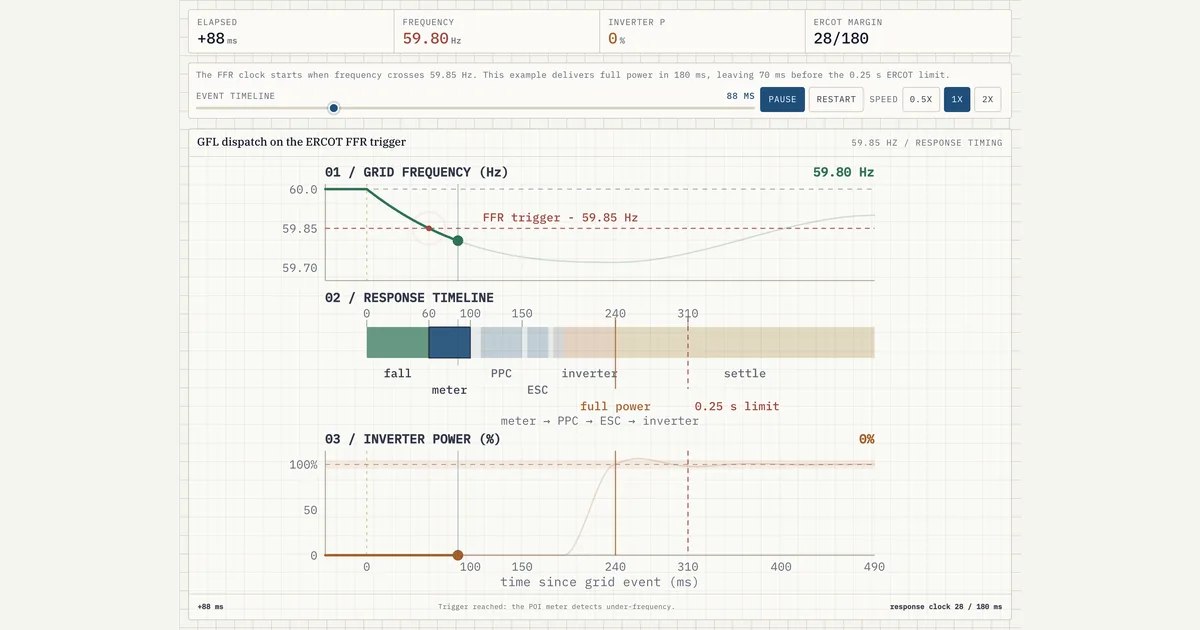
The timeline follows an under-frequency event from the moment grid frequency crosses the FFR trigger through the command path — POI meter, plant controller (PPC), energy storage controller (ESC), inverter — to delivered active power. Each hop adds latency; the example delivers full power well inside the 0.25 s ERCOT limit, leaving margin.
Why it matters for BESS
Fast frequency response is a revenue-bearing ancillary service, but only if the full detection-to-delivery chain fits inside the market window. Mapping the latency budget across the command path is how engineers prove a plant can qualify — and where they find the milliseconds when it cannot.
Frequently asked
- What is Fast Frequency Response (FFR)?
- FFR is an ancillary service in which a resource injects active power within a fraction of a second of a frequency deviation to arrest decline — far faster than traditional primary frequency response. ERCOT requires delivery within 0.25 seconds.
- Why is BESS well suited to FFR?
- Batteries and inverters can move from zero to full power in tens of milliseconds, so the binding constraint is the measurement and command chain, not the hardware — which is exactly what this timeline makes visible.
References
Standards and authoritative sources this visual is built on:
- ERCOT Nodal Protocols — Responsive Reserve Service and the Fast Frequency Response (FFR) component (0.25 s deployment requirement)
- IEEE Std 2800-2022 — Standard for Interconnection and Interoperability of Inverter-Based Resources (IBRs) Interconnecting with Associated Transmission Electric Power Systems (frequency response / fast frequency response requirements)
- Reliability Standard BAL-003-2 — Frequency Response and Frequency Bias Setting
- Fast Frequency Response Concepts and Bulk Power System Reliability Needs