Grid-Forming Droop
How grid-forming controls move frequency and voltage references under P/Q stress.
Download the Grid-Forming Droop diagram
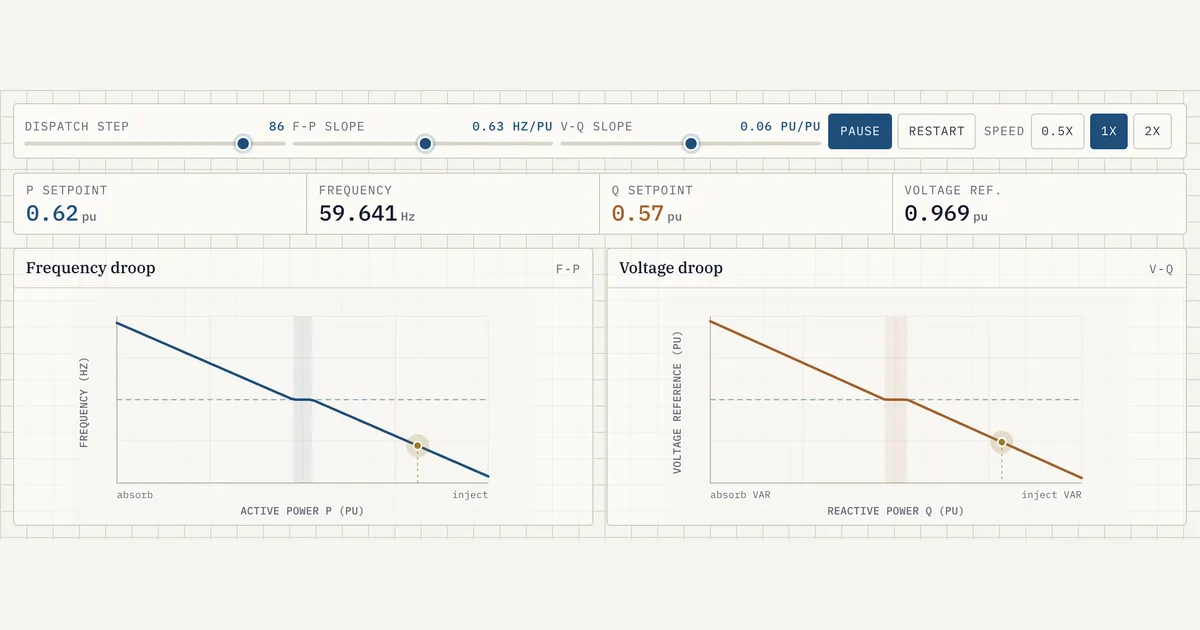
Free to download and reuse — including commercially — under CC BY 4.0, with credit to BESS.engineer. Licence & attribution →
Browse all BESS diagrams →
What it shows
A grid-forming inverter behaves like a voltage source behind an impedance. Its frequency reference droops with active power (f–P) and its voltage reference droops with reactive power (V–Q). The slopes set how aggressively it shares load with other sources; the dead-band keeps it from reacting to tiny deviations. The operating point slides along the curves as dispatch changes.
Why it matters for BESS
As synchronous generation retires, grid-forming BESS provides the voltage and frequency reference the grid used to get from spinning machines. Droop is what lets many inverters operate in parallel and share load stably without fighting each other — the foundation of inverter-dominated grids.
Frequently asked
- What is the difference between grid-forming and grid-following inverters?
- A grid-following inverter measures the grid and injects current in sync with it; it needs an existing voltage to lock onto. A grid-forming inverter sets its own voltage and frequency reference, so it can establish and stabilise the grid — including black start and islanded operation.
- What does the droop slope control?
- The droop slope sets how much frequency (or voltage) changes per unit of active (or reactive) power. A steeper slope means a given power change moves the reference more, which changes how load is shared between parallel sources.
References
Standards and authoritative sources this visual is built on:
- IEEE 2800-2022 — IEEE Standard for Interconnection and Interoperability of Inverter-Based Resources (IBRs) Interconnecting with Associated Transmission Electric Power Systems
- Grid Forming Technology: Bulk Power System Reliability Considerations (NERC White Paper, December 2021)
- Research Roadmap on Grid-Forming Inverters (NREL/TP-5D00-73476)
- IEEE 1547-2018 — IEEE Standard for Interconnection and Interoperability of Distributed Energy Resources with Associated Electric Power Systems Interfaces (frequency-droop and volt-var/dead-band response)