Black Start from a GFM Battery
A grid-forming battery energizes a dead network from zero volts — soft transformer magnetization versus inrush, converter current limiting, and load blocks picked up one at a time.
Download the Black Start from a GFM Battery diagram
Free to download and reuse — including commercially — under CC BY 4.0, with credit to BESS.engineer. Licence & attribution →
Browse all BESS diagrams →
What it shows
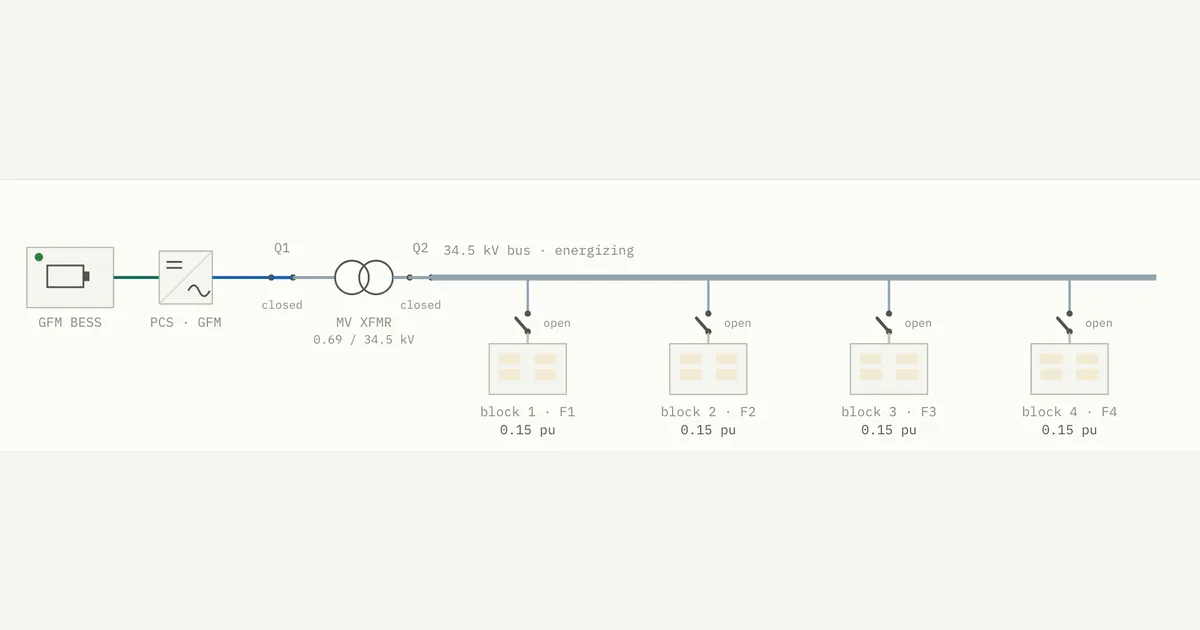
Black start is restarting a grid section from zero volts with no outside supply. Here one grid-forming (GFM) BESS energizes a dead 0.69/34.5 kV island through breakers Q1 (LV) and Q2 (MV). A soft V/f ramp raises voltage so transformer core flux never crosses the 1.15 pu saturation knee. Oscilloscopes trace bus voltage, delivered versus demanded inverter current against the limit, core flux, and the live magnetization curve as four load blocks are picked up one at a time.
Why it matters for BESS
Grid-forming inverters are increasingly asked to provide black-start service that synchronous plant once did, but a converter can only briefly source 1.2-2.0 pu of current, above its ~1.1-1.2 pu continuous limit — nothing like the fault infeed of a spinning machine. Energize a transformer by closing at full voltage and the core saturates past its knee, demanding 5-10x rated magnetizing current from a stiff source. The GFM either rides its limiter with distorted voltage or trips. The soft ramp is what makes converter-led restoration work at all.
How to read it
Watch CH 2: the red 'demanded' current is what the saturating core asks for; the orange 'delivered' current is what the converter actually supplies, clipped at the marked limit (1.2, 1.5, or 2.0 pu). In soft-ramp mode flux (CH 3) stays under the 1.15 pu knee and the two traces overlap. Switch to instant close and flux is driven toward 2 pu, the demand spikes, and the limiter engages. Each load block adds a current step and dips island frequency via droop; blocks bigger than the headroom collapse the island (EXP-04).
Frequently asked
- What is black start and can a battery do it?
- Black start is re-energizing a grid section from a fully de-energized state with no external supply. A grid-forming (GFM) BESS can perform it: acting as a voltage source, it energizes transformers, cables, and load blocks in an island. The catch is current — a converter reaches only about 1.2-2.0 pu even briefly, above its ~1.1-1.2 pu continuous limit, so it must ramp voltage softly to avoid the inrush a synchronous machine could simply absorb.
- Why does a soft V/f ramp avoid transformer inrush?
- Core flux is the time-integral of voltage (λ = ∫v·dt), so the core responds to volt-seconds, not instantaneous volts. A soft ramp raises the voltage envelope slowly, so flux tracks it and never crosses the ~1.15 pu saturation knee. Because the core never saturates, the 5-10x magnetizing inrush current is never demanded in the first place — not merely limited after the fact.
- What happens if the GFM converter closes into the transformer at full voltage?
- Closing at a voltage zero drives flux toward 2 pu via the 1−cos(ωt) offset, pushing the core past its knee into saturation. From a stiff source the magnetizing current would jump to 5-10x rated, but the converter can only deliver its limit (e.g. 1.2 pu). It then rides the limiter with distorted voltage and protection stress, or trips on overcurrent — the instant-close experiments (EXP-02, EXP-03) show both outcomes.
- Why does the island settle below 60 Hz after picking up load?
- The model uses droop-only frequency control with no secondary (restoration) loop, so each load block permanently lowers frequency in proportion to the power served — a loaded island settles below 60.00 Hz by design. Every pickup also adds a current step plus brief motor inrush; blocks must fit within the headroom between served load and the current limit, or the island trips on overcurrent — the converter hits its current ceiling before the voltage has time to collapse.
References
Standards and authoritative sources this visual is built on:
- Grid Forming Functional Specifications for BPS-Connected Battery Energy Storage Systems
- Research Roadmap on Grid-Forming Inverters (NREL/TP-5D00-73476)
- IEEE Std 2800-2022 — Standard for Interconnection and Interoperability of Inverter-Based Resources (IBRs) Interconnecting with Associated Transmission Electric Power Systems
- Distributed ReStart: Black Start from Distributed Energy Resources — Project Findings